GPT-4 isn't just a writing assistant.
When used intentionally, it can be a creative collaborator, scenario generator, and even a low-fidelity prototyping tool for services.
Here's how to move beyond the prompt and start shaping interactions with intelligence.
✳️ Why GPT-4 in Service Design?
Service prototyping used to mean sticky notes, sketches, or basic journey maps.
But with the rise of large language models (LLMs), we now have a tool that can:
- Simulate user responses
- Generate content across touchpoints
- Prototype dialogue and behavior in context
- Explore unintended consequences or edge cases
These capabilities aren't just theoretical.
Here are three real-world workflows that show how GPT-4 can support faster, smarter service prototyping.
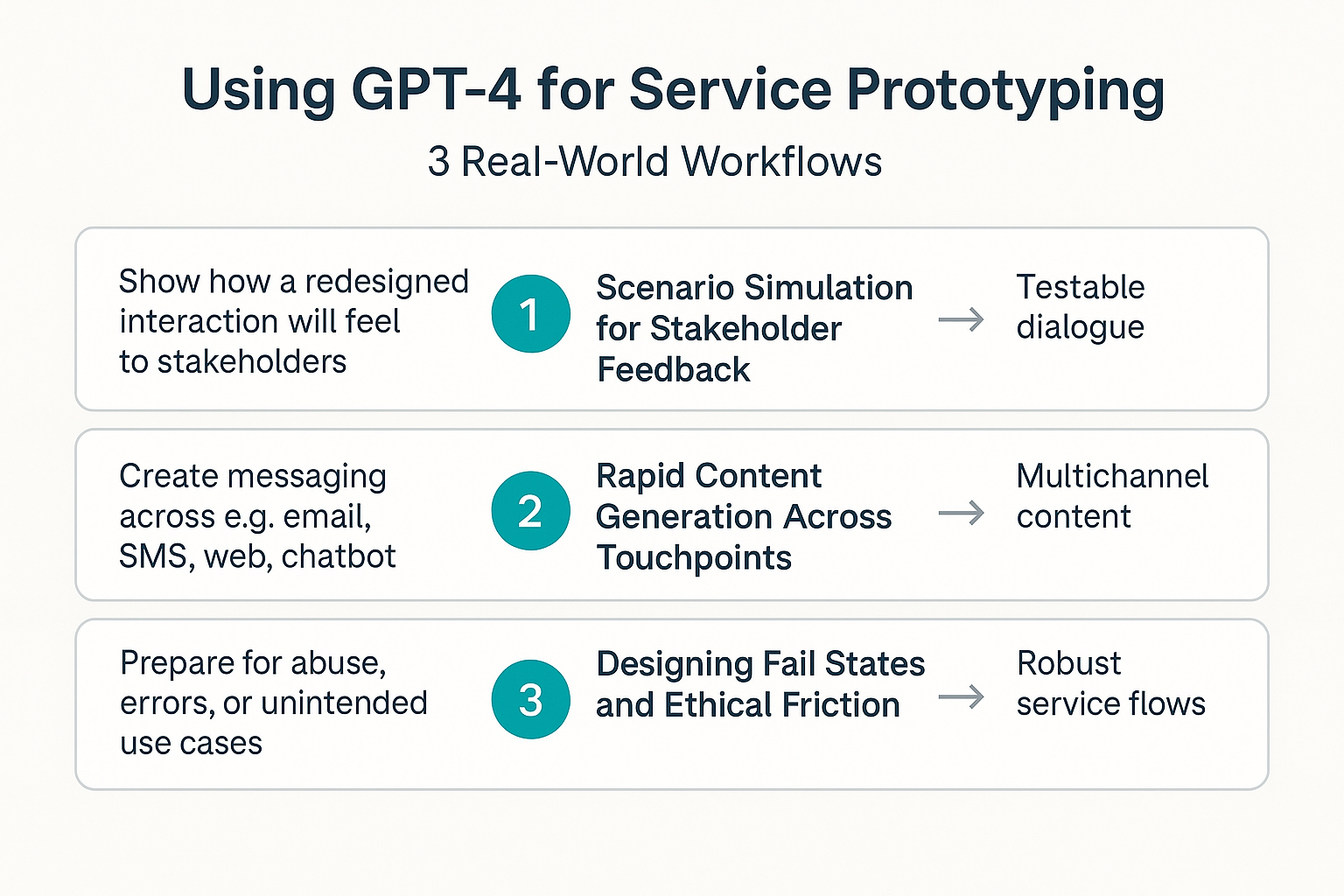
1️⃣ Workflow: Scenario Simulation for Stakeholder Feedback
Problem: You need to show how a redesigned service interaction will feel to different stakeholders, but you lack actors or a testing lab.
Solution: Use GPT-4 to simulate scenarios across roles.
How:
- Prompt GPT-4: “You are a working mother trying to apply for childcare subsidy online. Simulate your full emotional journey.”
- Alternate: Ask GPT-4 to role-play both the user and the customer service agent for a service hotline call.
- Refine the interaction: Vary tone, mood, digital literacy level.
Result: Instant empathy map + testable dialogue for stakeholder workshops.
2️⃣ Workflow: Rapid Content Generation Across Touchpoints
Problem: You're redesigning a government service and need consistent messaging across email, SMS, chatbot, and web — but copywriting is slow.
Solution: Use GPT-4 to generate and iterate content aligned to tone and context.
How:
- Feed in your service script or concept
- Prompt: “Write onboarding messages for each channel: email, SMS, chatbot. Friendly but formal.”
- Review and edit for tone, accuracy, and accessibility
Result: Prototype-ready, channel-specific content in minutes.
3️⃣ Workflow: Designing Fail States and Ethical Friction
Problem: Services often break — or are misused — but we rarely prototype for it.
Solution: Use GPT-4 to simulate abuse, error, and boundary scenarios.
How:
- Ask: “How might users misunderstand this refund system?”
- Or: “What if a user tries to use the chatbot for unrelated complaints?”
- Generate “bad paths” and use them to redesign with resilience and ethics in mind
Result: Robust service flows, safer defaults, fewer blind spots.
🧭 Design Synth Insight
Prototyping with GPT-4 is less about perfection and more about possibilities.
It's about speed, range, and scenario testing — not replacing design thinking, but accelerating it.
The most powerful prompts don’t ask GPT what to say.
They ask: What if…?
📡 Design Synth — Where intelligence meets empathy, and design shapes the future.
#GPT4 #ServiceDesign #AIforDesign #DesignPrototyping #UXDesignTools #HumanAIInteraction #LLMWorkflow #PromptEngineering #DesignSynth #FutureOfDesign
'I. Design Synth Manifesto' 카테고리의 다른 글
| The Three Languages of Design — Thinking, Ritual, Synth (0) | 2025.05.05 |
|---|---|
| 디자인의 세 가지 언어 — Thinking, Ritual, Synth (0) | 2025.05.05 |
| 디자인 씽킹을 넘어 - Design Synth 선언문 (1) | 2025.05.01 |
| The Design Synth Manifesto (0) | 2025.05.01 |

